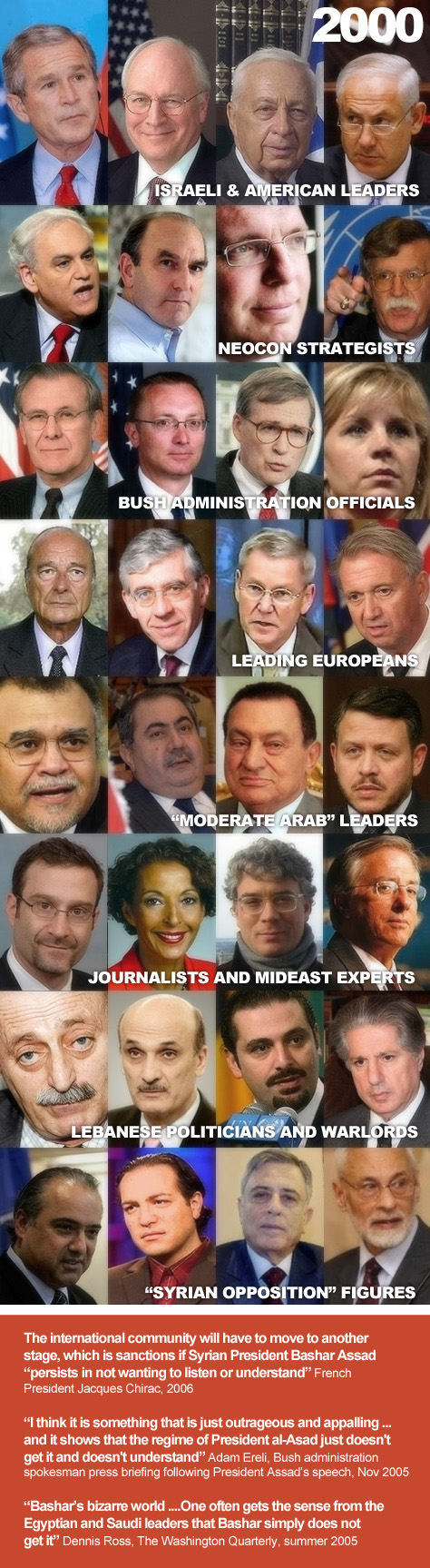
And now for something completely different.
If you’ve been following events in Syria, you’d know that the English-language press is mostly deeply critical of the Assad regime (while the Arabic press displays a slightly wider range of views). I thought it would be worth trying to present a minority report on the situation from a Syrian friend of mine, although, as you will see, he argues precisely that his position is actually held by a very significant majority (albeit a rather quiet and frustrated majority) of Syrians.
Camille Otrakji is a Syrian political blogger based in Montreal. Although he tends to keep a low profile, Otrakji has been, for the past several years, at the forefront of many of the most interesting and influential online initiatives relating to Syrian politics. He is one of the authors and moderators at Joshua Landis’s
Syria Comment, and the founder of
Creative Syria, a constellation of websites including
Mideast Image (a vast collection of original old photographs of Middle Eastern subjects) and
Syrian Think Tank (an online debate site hosting many of Syria’s top analysts). Last year, Otrakji
courted controversy with a new initiative devoted to the subject of Syrian-Israeli peace, entitled
OneMideast.org. He agreed to speak with me about the latest events in Syria, and I’m sure that his views will generate plenty of discussion.
*
QN: You were recently quoted in The New York Times, arguing that the current situation in Syria is “all being manipulated,” and that the activists are deceiving the Syrian public and the world. Could you elaborate on this? Otrakji
: I believe that a clear majority of Syrians support many of the demands of the peaceful protesters. On the other hand, only a minority of Syrians are willing to risk destabilizing their country in order to try to achieve full regime change after a painful drawn-out conflict.

You might disagree with me if your impression of the state of the protests movement is the product of Aljazeera and BBC Arabic endlessly looping some bloody clip of the day and creating an impression that victory is near for “the Syrian people” who are demonstrating against their despised tyrant. In the early days of the Libyan revolt, Aljazeera created the same “victory-is-easy” impression for the Libyan people and they believed it, and until today they are killing each other and destroying their country.
Despite weekly calls from
opposition figures for millions to demonstrate, based on the numbers of people we have seen in the streets of Syria thus far,
it is clear that less than 1.0% of the country (about 150,000 Syrians) has joined the protests. This is not
Egypt or
Yemen, where you had hundreds of thousands or even millions of people protesting every day. In Syria we’ve seen a few thousands here, a few hundred there, mostly on Fridays. And yet western governments, the Syrian opposition, and the media covering Syria are all enthusiastically and casually using the term “the Syrian people” from the first day a few young men demonstrated in the Ummayad mosque. This implies they have the support of the entire Syrian population, which is a very serious distortion of the facts. How do you think the pro-stability Syrians feel when everyone, from Western officials to journalists imply that they are automatically on the side of regime change?
No one reported that for weeks Syrians were demonstrating each night in many cities supporting their President. These daily demonstrations, festive and loud, stopped only when interior ministry told the supporters to stop showing their support because they were too noisy. The only time millions demonstrated in Syria was the day Assad’s supporters went to the street in most of Syria’s large cities. It was bizarre that most of the media decided that all these Syrians were
chanting and dancing in the streets because they were afraid of the regime, simply because schools and some government offices were given the day off on that day. Ironically, some of the same journalists were also making the point the revolution is bound to succeed because “the barrier of fear has been shattered”.
In addition to distorting the true size of the protests movements, everyone seems to overlook the fact that unlike Egypt’s Tahrir Square, Syria’s protestors have mostly been men. “The Syrian people” include women too, as you can see from the pro-Assad demonstrations. Why didn’t any of those Western financed women rights organizations express any concern after seeing tens of all-male demonstrations so far?While most protests were genuinely peaceful, many were confrontational and violent. Syria’s police and security personnel are not used to such challenges and sadly in some cases some of them probably reacted with unnecessary violence. But out of an estimated 150,000 protesters so far up to 500 died according to opposition figures. Government claims 78 died, and I believe the real figure is in between, closer to opposition figures. The government claims that many died in armed confrontations. Given that 80 soldiers and policemen also died, it is only logical that non-peaceful armed men were among the hundreds of “civilian” casualties. In other words, not all civilian casualties were peaceful protestors.Many others probably died through excessive security personnel violence. We need to keep in mind that despite the bitter feeling all of us today have after hundreds died, an investigation of what happened should be conducted.
None of us has access to the truth, but I think it is fair to conclude for now that the numbers imply that it is not true that there is an official policy of shooting randomly at any demonstrator. Many fatal mistakes took place, but many others died while they were taking part in non peaceful confrontations with the army or police. Those who compare Syria’s casualties figures to Egypt’s need to keep in mind that in Egypt protesters were not engaging the army in battles. The 850 who died there were all non armed.
QN: But surely there is public discontent with Bashar al-Assad, or else people would not be risking their lives to demonstrate against the regime.Otrakji:
The revolt started out as a legitimate one, when it was based in Dar’aa. The people there were genuinely fed up with the local head of security, who was a relative of the president, and so at first they protested against his abuse of power and his corruption. But this took place against the backdrop of the events in Egypt and Tunisia, so certain groups decided to try and capitalize on this act of protest in Dar’aa and turn it into a nationwide revolt.
QN: Which groups?Otrakji: There are many groups who are trying to destabilize the regime. You have the regime change activists overseas, who are financed by various
American programs that the Obama administration continued to finance despite seeking better relations with Syria. And you have American technologies that allow you to
manipulate anything online. For example, you can help generate virtual members among some of the 150,000 that the Syrian revolution 2011 page on Facebook is proud of.
QN: So this is all the work of these outside groups?
Otrakji: No, of course not. As I said, the revolt had a legitimate spark. And there is no doubt that many Syrians are dissatisfied with many aspects of the current regime. But most Syrians would much rather see some meaningful reforms undertaken in a peaceful fashion over the next five years under the current regime, instead of trying to sweep the regime away and dealing with the prospect of sectarian civil war.
If Bashar were to sign several laws:
(1) permitting the formation of political parties; (2) lifting the tight censorship in the press; (3) and modernizing and limiting the role of the mukhabarat (intelligence services), I believe that 80% of the Syrian people would be fully on board with that. They would say to the opposition: “Thank you very much for your courage. You did a valuable service by giving the regime a ‘cold shower’. But now we’ve had enough of the protests and we want to go back to work.
We will give Bashar the benefit of the doubt, until the next presidential election.”QN: What do you say to those who argue, like Joshua Landis, that the regime’s days are numbered? Landis recently suggested that even if Bashar can weather this storm, the country’s economic woes are a ticking time bomb and eventually the country’s middle class will abandon him.Otrakji: Dr. Landis might be right, it will be difficult. But I also want to point out that this is not exactly the first time Syria’s economy was predicted to be near collapsing. President Reagan was not the first to wait for his adversaries (the Soviet Union) to surrender after they go broke.
In 1977, when the United States and Israel decided to make peace with Egypt instead of going for a comprehensive peace treaty that included the full return of Syria’s Golan Heights and the occupied Palestinian territories, a key demand of Hafez Assad, National Security Advisor Zbigniew Brzezinski offered this analysis:
“The Syrian economy is in grave difficulty, with inflation running at 25%. If the Saudis were to offer major financial backing in return for a Syrian-Egyptian reconciliation, President Hafez Assad might have to assent, no matter how much he dislikes the idea of being forced to negotiate with Israel.”Thirty four years later, we are facing a similar situation. The west is sending Syria messages through their Gulf Arab allies that say
“You are in real trouble, if you play by our rules … if you terminate relations with Iran and disarm Hezbollah … if you cooperate with us when we need you to, then we can help you stay in power and turn a blind eye like we do in Bahrain or Saudi Arabia”.This is not the most difficult challenge that the regime had to face. In 1977 it lost its Egyptian peace partner after Sadat signed a separate peace treaty with Israel. At the same time the Syrian regime was in Lebanon busy fighting a coalition of Muslim forces as it tried to protect the much weaker Christians.
This led to a coalition of neighboring Arab states aligned with the Untied States and determined to overthrow the Syrian regime by supporting (financially and with arms) the Muslism brotherhood that tried to use force to overthrow the regime. Then Israel invaded Lebanon and defeated the Syrian army stationed there. The Syrian economy was suffering from years of grave and multiple challenges. Yet by 1983, a top U.S. State Department official had to admit: “Hafez Assad is as strong, perhaps stronger, than ever.” In 2005, after the Hariri assassination,
the entire world was out for Syrian blood. The Syrian army left Lebanon, and the Americans, Europeans, and the Arabs all thought that Bashar was finished. They said he was stupid, he had no vision, he was not even half the man that his father was. It is instructive to consider the fact that Bashar did not feel pressured to properly comment on the Hariri assassination and Syria’s withdrawal from Lebanon. Rafiq al-Hariri was killed on February 14, 2005.
Do you know when Bashar gave his first full address about the issue? November. When pressured, the Syrian regime takes the long view. It is a mistake to assume they have no cards to play.QN: Can they afford to not communicate for that long?Otrakji: It seems they believe they can. But this total lack of communication is making them lose popularity among those who used to be independents, and it is making many regime supporters furious. They would like to hear a convincing account of what is happening, but the regime hates to communicate.
As a result, many supporters are by now on the fence. They prefer to suspend the revolution and give the regime enough time to reform as promised. But every Friday is forcing them to go through the painful exercise of waiting until the end of the day to hear the bad news. Last Friday, tens died.
The regime’s opponents imply they were all peaceful protesters. The regime implies they were all armed men who attacked or were attacked by the army or police. Most Syrians believe the truth is somewhere in between.On the other hand, I realize that communicating might be near useless anyway. Both the regime supporters and the opposition are engaged in serious propaganda and the result is that the more technology tools we have today, the more confused and suspicious we are.
On Twitter you have a massive amount of fabricated opposition claims of regime brutality (in addition to the true ones). On facebook you get to see video clips that every group shares (if they support their arguments) or rejects (if it is embarrassing).
This report from Syrian television claims that tens of demonstrators were actually only celebrating rainfall. This clip of a funeral of those who died at the hands of security shows a flying coffin that seems to be empty. I like this clip. It is funny, and it demonstrates how anyone with a bit of technical background, can manipulate digital media with ease.
QN: Why did Egypt go more smoothly?Otrakji: There is a major difference with Syria. Egypt does not have the complex sectarian and ethnic makeup that Syria does. We have Sunnis, Alawites, Christians, Druzes, Kurds, Armenians, and various other ethnic and confessional groups. We have tribalism. We share borders and complex political ties ad history with Lebanon and Iraq, two of the most volatile countries in the region. We are in a state of war with Israel, and we are a central member of the Iranian-Hizbullah-Hamas axis that puts us in the crosshairs of Saudi Arabia and other Arab states.
All Syrians are aware of their country’s vulnerability to instability, which is why the vast majority are genuinely supportive, or tolerant, of the current regime, even if they are restless waiting for more reforms. Syrians are risk averse; they’re just not willing to take the risk that Egypt took, because Egypt has much less potential for internal fragmentation. It is 90% Sunni Muslim, 100% Arab, no tribes, no Kurdish issue, has endless empty deserts separating it from its neighbors, and opted to sign a peace treaty with Israel ending its state of war.
QN: So what’s going to happen?Otrakji: There is no way to know. Ultimately, it’s in the hands of the mostly non-sectarian risk-averse Syrian people, but it could still spin out of control if the current events are manipulated by groups that are trying to stir up sectarian conflict. If you read the older posts on the Syrian Revolution Facebook page (before they got a facelift and professional PR help), you wouldn’t believe how much religious language you find, and also how much deception there is.
They were trying to whip up sectarian hysteria, to radicalize Syria’s Sunnis so as to bring down the regime. This is not what most Syrians want, but they have enough Syrians they can potentially influence.QN: What is the likelihood, in your opinion, that the regime can be toppled by the current opposition, assuming that they can garner more support in the main cities?Otrakji: The problem with this question – which everybody is asking – is that it fundamentally misunderstands the whole idea of “the Syrian regime”. What does this mean? What are you talking about when you say “the Syrian regime”?
QN: The Assad family, for starters. The major power-brokers and security chiefs. The corrupt oligarchs like Rami Makhlouf. Those are the opposition’s targets.Otrakji: Corruption is indeed part of the reason many in “the regime” will resist those trying to force them out and I don’t think the Syrian people will rest anymore unless they are convinced that corruption will be curtailed.
But I think we need to look at Lebanon to understand what is really happening in Syria. After decades of Lebanon’s experience with democracy (flawed democracy) you still had Amin and Bashir Gemayel inheriting the leadership of their party and people from their father Pierre. Walid from Kamal Jumblatt, Saad from Rafiq Hariri… and the same applies to the Frangiehs, Chamouns or the Karamis.You also have an understandings where a 5% segment of the population (the Druze minority) can sometimes have a veto power over potential decisions that the nation’s elected leaders might be contemplating.
When Druze leader Walid jumblatt switched to the March 8 side, providing them with a new majority and the right to name Lebanon’s next prime minister, Saad Hariri was furious. He warned that only the Sunnis can name the country’s (Sunni) prime minister, regardless of who has a parliamentarian majority.
Although there is no strong regime in power like the one in Syria,
Lebanon still did not yet feel ready to take the risk to try to adopt one-man-one-vote democracy. And the same families that collectively held power over the different segments of society are still there decades later. Even Sayyed Hasan Nasrallah has been there for decades. Messing up with this imperfect system can open a can of worms.
Iraq’s current government coalition was mostly made in Damascus. Every candidate and major political or religious figure visited Damascus before an agreement was reached. No other capital in the region or outside received that many Iraqi VIP visitors.
How did Syria get to be that influential in Iraq?When Saddam Hussein oppressed Iraq’s Shia and Kurds, Syria protected their leaders in Damascus. Iraqi Prime ministers Maliki and Allawi, President Talibani, and many other Iraqis opposed to Saddam Hussein
were living safely in Damascus for years before they went back to the new Iraq to lead it. At that time, all the other Arabs, not to mention the United States and Europe, were trying to be Saddam’s best friends.Similarly, when Iran’s weight in post-Saddam Iraq tilted the country’s political balance in a way that marginalized Iraq’s Sunnis, Syria opposed its Iranian allies and decided to protect Iraq’s Sunnis, including the Baathist and Sunni tribal leaders in Iraq.Lebanon’s majority coalition is made of Christians, Shia, Druze and Sunnis … all of them have one thing in common;
They are Syria’s allies. Similarly, Lebanon’s opposition is made of a similarly colorful group that also has one thing in common …
all are opponents of Syria. When Druze leader switched from being an opponent of Syria to a friend of Syria, the majority and opposition in Lebanon exchanged hats.
The Syrian regime, and only the Syrian regime, REALLY know how the Levant and Mesopotamia work. Try to let the Saudis decide and you will end up with one disaster after the other. Remember
Saud Al-faisal‘s brilliant plan to send an Arab army to fight Hezbollah in Lebanon?
The Alawites, and to a lesser degree the other minorities in Syria, will not accept the current system to be swept away overnight and without reforms that guarantee minority safety and rights.
You have to understand that most Alawites view Syria in much the same way that the Jews view Israel, the Kurds view Kurdistan, the Maronites in Lebanon, etc. This is the one country in the world where they can dictate their own affairs and don’t have to worry about being repressed as a minority. They are not going to accept that this reality changes overnight. If democracy is to come to Syria, it needs to happen gradually and in a region that is not boiling in sectarian anger.
Most Syrians understand this. But many, understandably, do not.QN: What is your opinion of Turkey’s alleged concerns over the Syrian government’s crackdown? Do you think that this valuable alliance could be in jeopardy if the violence continues and refugees start fleeing to Turkey?Otrakji: If Syria collapses, this could lead to a potential disaster for everyone in its vicinity: Lebanon, Israel, Palestine, Jordan, Iraq, and yes, even Turkey. The Turks have no desire to see Syria’s Kurds beginning to demand their own statelet, as this will impact Turkey’s Kurdish question in a major way. And Turkey surely would not want to see Sunnis and Alawites fighting each other just south of its border. These things can be contagious to Turkey’s own Sunni/Alawite population.
The main players in the region
have no interest,
at the end of the day, in trying to destabilize Assad. Even if they hate to admit it, they know that Syria’s regime plays a stabilizing role across the region.
Rami Khouri agrees that we can expect major problems across the region if Syria is shaken. I think Syria has influence as far as Yemen, Saudi Arabia, Iraq, Lebanon, Jordan, Turkey, Iran, Bahrain and … everywhere.
In that sense, Syria is really not Egypt or Tunis.QN: What’s the best case scenario for Syria, in your opinion?Otrakji:
I can’t discuss Syria without also discussing the Middle East. Here is the only thing that will work:For now, demonstrations must stop, the President must speak to the nation to reassure everyone that he is indeed committed to serious and accelerated reforms that will please most Syrians. Press freedom law, political parties law, decentralization law (more power to the provinces) and gradually (within a year?) undoing the Ba’ath party’s monopoly on power.The minorities in power in Syria need to start thinking of a five year plan to move to a democratic system. A Senate can help protect minority rights. Maintaining control of the army, like the case in Turkey, can provide another way to reassure the minorities. But otherwise, free elections that might bring anyone to power should be expected… after peace with Israel (please bear with me, I’ll explain)
“The International community” must help Israel and the Arabs reach comprehensive peace in the Middle East. The status quo is not sustainable. A majority of Egyptians want to scrap the peace treaty with Israel. Saudi Arabia and the other Gulf states are not going to remain stable forever. Iran and Saudi Arabia are probably going to consider different ways to escalate their cold war. Soon, a third intifada might start in the Palestinian territories. There is one way to start undoing all the pressure, a comprehensive peace treaty that is based on the return to the 1967 borders.
Since 1977 the US and Europe have been trying to weaken or destabilize Syria. This will destabilize the whole Middle East like it did each time they tried in the past. In Washington DC there is a group of legacy Middle East experts who tried, unsuccessfully, over the past years or decades, to weaken and isolate Syria. Dennis Ross, Elliott Abrams,
Lee Smith, Jeff Feltman, and many others who passed away. For them, it is a personal battle that they never won. But they succeeded at least in ensuring that Syria never received a visit from an American secretary of State since 2003. No matter who is the President of the Untied States, one of the long term enemies of Syria makes it inside the new administration to help ensure nothing constructive comes out.
If President Obama is serious about progress in the Middle East, he has to personally take charge of relations with Syria. Leave the Syria “experts” out of it. You cannot be a democracy within the borders of the United States but a bully in the way you deal with smaller states. You know that
when Syria was considered an ally of the Soviet Union, the Russians allowed Hafez Assad the liberty to meet with American Presidents. They did not punish him for that. The same applies to Iranian allies of Syria. They never complained when President Bashar Assad met with American officials or when Syrian experts were discussing peace with Israelis in Turkey. The US should learn from Iran and the former Soviet Union how is it possible to be a friend of Syria without dictating your terms on your weaker friend.
Religion and politics make an explosive mix. Most of the region’s problems come from
Saudi Arabia (Sunni Islam’s Kingdom), Iran (Shia Islam’s kingdom) Israel (the Jewish state) and soon from America’s
Zionist Christians.
If you want Syrian minorities to be less fearful of full democracy get the Salafists off their back first. This one is calling for sacrificing one third of Syria’s population to get rid of the infidels, while the other one is about to explode if he does not see the minorities out of power in Syria immediately. In Egypt, top leaders of the Muslim Brotherhood are saying their real goal is “
to rule the world!”. Salafists in Egypt are already threatening to enter Christian monasteries and to take over Sufi mosques. Even in Tunisia, Jordan and Northern Lebanon, Salafists are increasingly trying to play a big role.
In five years, everything can be resolved. But we have to retire the “moral clarity” mentality that used to consider Hosni Mubarak a part of the “International community” simply because he was a US puppet. Many of the heroes and
prophets of moral clarity worked for Qaddafi when he paid the right price. Some of them worked for the Bush Sr. administration when a decision was made to kill tens of thousands of young
Iraqi soldiers after they surrendered. That same 1991 war was made possible after many, including the President,
lied to the American people to help them support that initially unpopular war.

Don’t try again to spend 500 million dollars to manipulate the Lebanese people against Hezbollah before they go to vote. When you do that, the Syrian regime will be more assured that opening up its political system will lead to American (and Saudi) manipulation… until both countries accept to become genuine friends of Syria. It is really wrong for the Obama administration to send an ambassador to Damascus while trying to finance those who are trying to overthrow the regime then to complain that engagement with Damascus is not working too well.
The United States must decide between solving the problems of the region, or letting it explode.
Forget what your Syria experts say; Syria is where you need to start. This regime has 40 years of intensive and extensive experience in this region. Make use of it, THEN talk to the regime about what it takes to retire from power while the region is at peace.
Am I confident any of that will take place? … The regime’s reforms yes, the rest no. It is hard not to be pessimistic about what the region will go through this year.
 ابراهيم الأمين

 Uprooted Palestinian